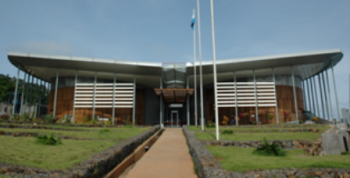
Special Court for Sierra Leone

Special Court for Sierra Leone
On February 24-26, 2011, York Law & Society Professor, Annie Bunting, the Coalition for Women’s Human Rights in Conflict Situations, and The Harriet Tubman Institute for Research on the Global Migrations of African Peoples hosted an unprecedented international conference on the topic of forced marriage in conflict situations in Freetown, Sierra Leone.
Bringing together historians of slavery and women’s human rights scholars, survivor groups, local NGOs, officials and leading academics and activists working on the issue, the conference explored the phenomenon of forced marriage and enslavement from comparative and historical perspectives. During conflicts in Sierra Leone, Liberia, the Democratic Republic of the Congo (DRC), Uganda and Rwanda, women were kidnapped, raped and forced into “marriages” with combatants. The Special Court for Sierra Leone recently found such gender violations to constitute a new crime against humanity of “forced marriage” as opposed to “sexual slavery”. The international expert group explored the merits of prosecuting those responsible for forced marriage under the headings of “sexual slavery”, “forced marriage” or “enslavement”. It also focused on the historical antecedents of servile marriage and enslavement of women.
The conference is the second of two events supported by a Social Sciences & Humanities Research Council of Canada International Opportunities Fund Grant. In October 2010, Bunting hosted an international research workshop on the issue at York University. Research team members for the international project include Rosaline M’Carthy, chair of the Women’s Forum in Sierra Leone, which is a national umbrella organization of women’s groups in the region, representatives from the Coalition of Women’s Human Rights in Conflict Situations, the Feinstein International Center at Tufts University, Free the Slaves, the Harriet Tubman Institute, the Open Society Initiative for Eastern Africa, Rights & Democracy, l’Université du Québec à Montréal, the University of Liverpool, the Women’s Forum, and the Wilberforce Institute on the Study of Slavery and Emancipation.
February 24-26, 2011
Freetown, Sierra Leone
Conference Hotel:
Hotel Barmoi
http://www.hotelbarmoi.com/
General Information on Freetown, Sierra Leone:
http://www.visitsierraleone.org/
[Visa, vaccination, transportation information and much more]
Please see attached below.
Principal Investigator: Annie Bunting, Associate Professor in Law and Society, York University
Research Assistant: Karlee Sapoznik, Ph.D. Candidate, York University
International Participants:
Local Participants:
Please see attached below for the biographies of the participants.