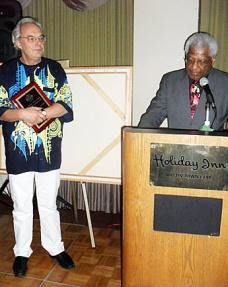

York Distinguished Research Professor in African history Paul Lovejoy, director of the Harriet Tubman Institute for Research on the Global Migrations of African Peoples, was chosen over 10 other nominees to receive this year’s Distinguished Africanist Research Excellence Award from the University of Texas at Austin for his dedication, lifetime of service and contributions to the discipline.
Citation: Distinguished Africanist Award
We received eleven nominations for the Distinguished Africanist Award, dedicated to life time service and enormous contributions to the discipline in academic and practical manners. Previous winners are the photographer and medical doctor, Alfred Fayemi, two notable scholars (the late Professor Ogbu Kalu and Jacob Ade Ajayi, former President of the University of Lagos), and two publishers, Keith Sipe of Carolina Academic Press and Kassahun Checole of Africa World Press.
This year, our winner is a professor of African history, Paul Lovejoy. Competing with an Ambassador in UNESCO, a university president, a business man, the President of Liberia and a host of very distinguished professors, the Committee unanimously voted him for this award for combining various aspects of the profession. All our winners require no introduction!
Professor Paul E. Lovejoy is a Fellow of the Royal Society of Canada, Distinguished Research Professor and Canada Research Chair in African Diaspora and Professor of African History at York University, Toronto Canada. The aspects of his career that most concretely demonstrate the criteria of this award are outlined below.
For more than three decades Professor Lovejoy has dedicated his career to research and teaching in African History. His research and publications have had a major impact on African history and African diaspora studies, including cultural studies, anthropology, and demography. He has authored five books and over eighty chapters and articles in learned journals, and has edited or co-edited more than twenty-five volumes and three scholarly series. He is series editor for the Harriet Tubman Series on the African Diaspora, Trenton, New Jersey and Continuum International Publishing Group, New York and London, with an initial twenty volumes set for publication by the end of 2010. In some of his many recent publications, he has reopened debate on the role of slave and the slave trade in Africa. Although trained as an economic historian, Prof Lovejoy has argued forcefully that slavery and the slave trade were unlike any other institution or trade. Slaves, he argues, were "people" active in the shaping of their world and not ‘things’ as commonly expressed in many slave studies. He postulates the reading of ‘slave memoirs’ be read as ‘liberation voices’ and his works on Kabba Saganugu, Mohammed Baquaqua, Olaudah Equiano and Sultan Mohammed Bello reflect African dignity and African contributions to anti-slavery. His international reputation is reflected in the translation and publication of his major work, Transformations in Slavery: A History of Slavery in Africa (Cambridge University Press, 1983, 2000), in the prestigious Civilização Brasileira in Brazil, the award of an honorary doctorate degree by the University of Stirling, and his membership on the International Scientific Committee of the UNESCO "Slave Route" Project. His research contributions have been recognized by the Royal Society of Canada, a Canada Council Killam Senior Research Fellowship, the Wallace K. Ferguson Prize of the Canadian Historical Association in 1994 for Slow Death for Slavery: The Course of Abolition in Northern Nigeria, 1897-1936 (Cambridge University of Press, 1993), and the Certificate of Merit in 1990 from the Social Science Federation of Canada for Transformations in Slavery, 2000.
The mentoring of students and junior colleagues is an essential ingredient of any successful research program, and he has a long standing and supportive relationship with his students, former students, junior faculties and colleagues. He has incorporated their input into conferences and research projects, and assisted in their intellectual and professional development. His mentoring activities extend beyond York to include those within the larger Tubman "network" as well to enduring networks emanating from his graduate school days at Wisconsin. Through the network, Prof Lovejoy has assisted many universities and colleagues in Africa, the Caribbean and South America with scarce archival and published materials, digital cameras, computers and scanners. He has pioneered a research centre on African diaspora based on a collaborative research program that is interdisciplinary and that crosses language boundaries. He has had the good fortune of recruiting talented graduate students from a number of different countries, and from such distinguished institutions in Nigeria, Iran, Morocco, Ghana, Angola, Cuba, Brazil, Mexico, Canada, United Kingdom, Somalia, Botswana, Kenya, Tunisia, Algeria, and Barbados. This makes York University one of the major training grounds for African and Africanist professional historians in North America. He has also served on doctoral dissertation committees in Scotland, UK, Costa Rica, the United States and Jamaica.
The number of linkages with other institutions in which he has been involved in researches related to Africa and its diaspora is considerable. He has been Research Professor at the Wilberforce Institute, University of Hull, Visiting Professor at El Colegio de Mexico, Directeur d’étude invitée at Centre d’étude africaines, Ecole des Haute Etudes en Sciences, Paris, and Honorary Lecturer in African Economic History at Ahmadu Bello University, Nigeria. In addition to his role at UNESCO, He is a collaborator on several major granting initiatives, including those with Centre National de la Recherche Scientifique (CNRS), Paris, the Wilberforce Institute for the study of Slavery and Emancipation (WISE), University of Hull, Universidade Federal de Fluminense, Brazil, and the Center for Latin American Studies, Vanderbilt University. He has participated in several digital archiving projects, capturing in electronic form records under threat of damage or destruction, and he has organized or co-organized 28 conferences, workshops and symposia that have required collaboration with numerous institutions and associations.
His various awards and honours recognize a continuous commitment to research, which has been sustained at a high level throughout his career, and is reflected in his extensive history of publication. His record as a researcher is similarly evident in the receipt of numerous Standard Research Grants from Social Science and Humanities Research Council of Canada (SSHRC), as well as three Major Collaborative Research Innovation (MCRI) grants, several Aid to Research Workshops and Conferences in Canada grants, and awards from the British Library, partnerships with National Endowment for Humanities (NEH), the Australian Research Council, and other granting sources. He is currently the recipient and principal investigator or collaborator for five research grants.
His record in securing significant research funding, some of which go into training students in African history, is considerable, most notably including grants from CFI, OIT, IBM, SSHRC, CRC, British Library, NEH, and the Australian National Council. He has outstanding grant applications in excess of $4.6m that involve projects that are being developed in ten countries. The frequency of his speaking engagements and the centrality of his scholarship to important debates currently raging in the journals indicate how his reputation reflects on the University. Prof Lovejoy is a central to the inauguration of an international research video festival to highlight documentaries arising from fieldwork on the African diaspora. These contributions to research culture reflect his dedication to scholarship, administrative leadership, mentoring, interdisciplinary innovation, and the collective reputation that he has invested in African studies.