
CALL FOR PAPERS
Past and Present An International Interdisciplinary Conference was held at the Wilberforce Institute for the study of Slavery and Emancipation, University of Hull.
26-28 September 2008
This conference marked the bicentenary of the establishment of Sierra Leone as a British Crown colony in 1808.
Sponsors:
Liverpool Hope University
The Harriet Tubman Institute for Research on the Global Migrations of African Peoples (York University)
Wilberforce Institute for the study of Slavery and Emancipation (University of Hull)
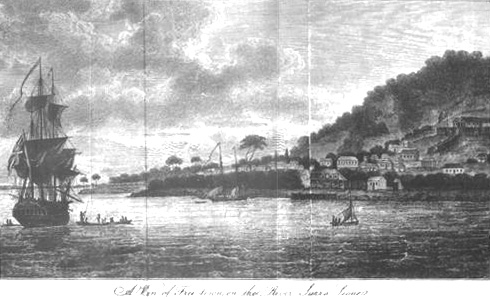
‘A View of Freetown on the River Sierra Leone’, British Library Shelfmark 979.h.25. and published in
Thomas Winterbottom, Account of the Native Africans in the Neighbourhood of Sierra Leone (London, 1803)
In 1808, two hundred years ago, Sierra Leone became a British Crown colony. The bicentennial presented the opportunity to re-examine the history of Sierra Leone. The conference brought together academics from different disciplines, museum professionals, archivists, policy makers concerned with contemporary issues, and individuals interested in human rights and the reconstruction of modern day Sierra Leone.
British influence in Sierra Leone is long standing and took a variety of forms in the transition from slavery to civil society from the eighteenth century to the present day. This part of West Africa was not only a slave supply region on the upper Guinea Coast but also the location for a number of abolitionist experiments in the late eighteenth and early nineteenth centuries. Leading British abolitionists, including Granville Sharp and William Wilberforce, regarded Sierra Leone as a ‘Province of Freedom’ that would transform Africa. It was hoped that the utopian vision of a settlement governed by former slaves would demonstrate African capacity for cultural, moral and economic improvement. To that end, the aims of the Sierra Leone Company, incorporated in 1791, were the destruction of the slave trade and the regeneration of Africa. The development of Freetown in a slave trading region was a bold and ambitious experiment in the implementation of morality and abolitionist economics. Although the Company aimed to develop ‘legitimate’ forms of trade as alternatives to the transatlantic slave trade, it failed to achieve its aims, and in 1808 the settlement was formally transferred to the British Crown. Sierra Leone experienced a number of phases of resettlement by people of African descent. In 1792 over 1,100 former slaves from Nova Scotia resettled in Freetown with the intention of making their ‘children free and happy’, and some 550 Maroons from Jamaica arrived in Sierra Leone in 1800. After 1807, anti-slavery squadrons disembarked tens of thousands of ‘recaptives’ from various parts of West Africa at Freetown. These immigrant groups constituted a ‘great mixture of Africans … [who] had to rebuild identities and communities in an alien land controlled by Europeans’, as David Northrup has recognized. Through their missionary and commercial endeavours, the ‘recaptives’ also influenced economic, social, and religious development in other areas of West Africa.
This conference offered scope to examine the legacies of slavery, abolition, and colonial rule in Sierra Leone. The conference explored British interaction with indigenous groups, the influence of European administrators on economic and cultural policy, and the activities of immigrants in establishing a unique cultural, religious and social identity. Moreover, the legacy of this past was explored in the context of the long history of colonial rule in Sierra Leone and the subsequent difficulties of establishing a civil society in the post-colonial era.
The Wilberforce Institute for the study of Slavery and Emancipation was a particularly appropriate venue for the conference because Freetown, Sierra Leone, and the City of Hull have been twin cities since 1980. The visit of former P.M. Tony Blair to Sierra Leone in May 2007 highlighted the ongoing links between Britain and Sierra Leone and the difficulties of reconstructing civil society in the aftermath of brutal civil war. With the return to peace in 2002, Britain agreed to provide development aid to rebuild Sierra Leone, which had become one of the world’s poorest countries. Hence, the conference focused on the reconstruction of civil society, both in the context of slavery and abolition and in the context of civil war and its aftermath. In recognition of the historic reasons that Hull and Freetown have been twin cities, the conference provided a forum to discuss past and present issues of social justice and civil development.
An edited collection of papers presented at the conference will be published. Direct all correspondence to:
Jane Ellison
Conference Manager
WISE (Wilberforce Institute for the study of Slavery and Emancipation)
University of Hull
Oriel Chambers
27 High Street
Hull, HU1 1NE
Tel: 01482 305182
Fax: 01482 305184
Email: [email protected]
www.hull.ac.uk/wise